

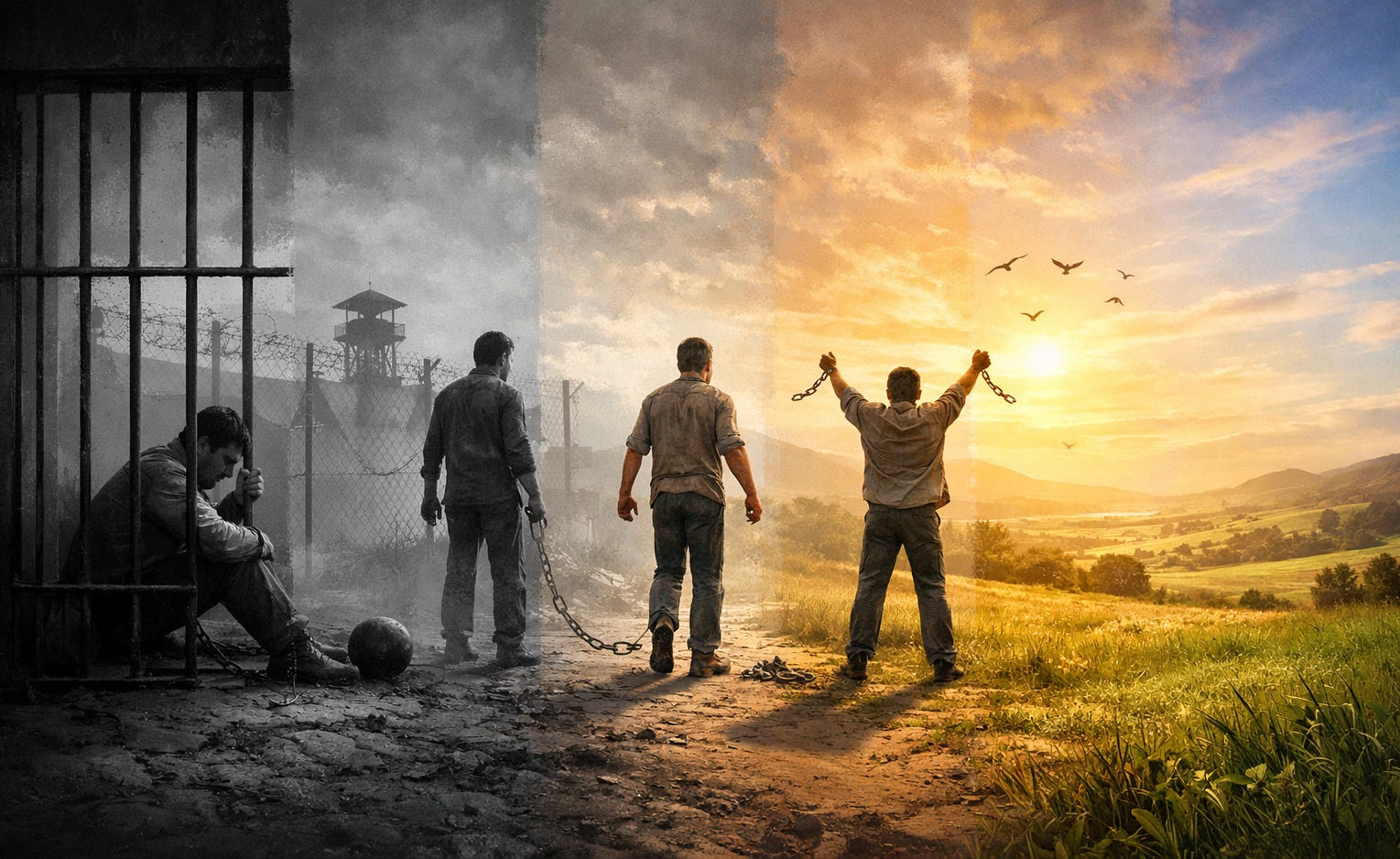
By now, you might have the feeling that I am trying to pull you into a Matrix-like storyline that leaves the viewer hopeless or freaked out. Yes, the realization of the entanglement we live in can be overwhelming. Recognizing this constructed reality we were previously unaware of can easily make us forget that we still have agency and freedom of choice.
Once you recognize the farm, the first instinct is to run. Get out. Drop out. Move to the countryside, grow your own food, delete your accounts, opt out of the system entirely. It’s the knee-jerk reaction to feeling trapped: if the cage is real, then freedom must mean escaping it. But where exactly are you running to?
Look, the question isn’t where you go. It’s how you understand what you’re playing.
It’s tempting to think of life as one fixed game. One you didn’t choose and still have to play. Some people rave about how great this game is; others complain endlessly that it’s unplayable, and some others only dare to play it in easy mode and then complain that it is boring. The game is the same for everyone. What matters is how you develop your character, and whether your skills match the level you’re playing. If you gain experience and get a few tips and tricks, everything becomes easier and more enjoyable, but until then it can feel brutally hard.
It is extremely difficult to master diverse skills at the same time. Think about someone who is good in accounting and administration but physically tied to sit in a chair most of the day, and when finally has a day off, he has difficulties to move. Or think about a handyman who is flexible, smart, installs and fixes systems, knowledgeable about tools and materials, and has multiple skills. Yet his “hammer-like fingers” make it hard for him to handle basic keyboards or touchscreens, so even the most useful apps and digital tools become a barrier to him. The degree of captivity depends on whether your abilities and your environment clash or align.
Freedom is not black and white, and it is not linear. Developing adaptive capacity among diverse skills and dimensions like physical, mental, social, spiritual is rare and difficult. Yet this is exactly where the gradient of freedom reveals itself. Freedom isn’t about escaping constraints; it’s about expanding the range within them.
At first, it is simply about learning the rules of the game, and later it becomes more like fine-tuning an instrument. Awareness and practice are the key. Game, instrument, life — the pattern repeats itself. Mistakes, even the painful ones, are part of the training. Each wrong turn teaches far more than passive comfort ever could.
Freedom is ultimately a gradient, measured in the degrees of captivity you are aware of and actively negotiating. And despite all fantasies of dropping out, you can’t step outside the game entirely. The game is civilization. The real question is not whether you can escape it, but how consciously you are choosing to play.
There are people living in the middle of nowhere, with low living costs and even homegrown food. No office, no commute, no landlord breathing down their neck. By most external measures, they’ve “escaped.”
But they are glued to the news. Smoking all day. Drinking often. Physically free, but psychically captured. The environment looks free-range, but the inner life tells a different story.
At the same time, there are people living in dense urban environments, surrounded by infrastructure, schedules, and systems. They have less physical space and far more rules. Yet many are deeply conscious about their health. They don’t drink or smoke. They move well. Some still run marathons at 70+, others do CrossFit in their eighties. Their lives are structured, but not collapsed.
Seen side by side, it becomes difficult to argue that freedom is simply about location. The countryside doesn’t guarantee it. The city doesn’t eliminate it. What matters is how people relate to their conditions, habits, and bodies over time.
This is where the gradient becomes visible. Freedom and captivity don’t arrive as opposites. They show up in degrees, layered into everyday choices, routines, and forms of attention.
The shift has to be mental and spiritual before it is geographical or logistical. It begins with awareness, learning to notice the rules of the game you’re already playing. You will make mistakes. Some choices will hurt. That’s not a failure of the process. That is the process. This is how you learn to play, how you fine-tune the instrument while already being inside the song. I’m not here with ultimate answers. I’m here to show contrasts I’ve encountered along my own path, and to suggest that the farm is not a prison you escape. It’s a condition you navigate.
The stories of Mowgli and Tarzan already hinted at something important. Even more than a century ago, a fully nature-integrated life was already so distant for urban dwellers. From the comfort of their homes, they could only imagine such a way of life through fiction. For them, this kind of freedom was never plausible, but something closer to a fantasy or a dream.
We’ve been dreaming of escape for over a century.
Maybe the dream itself is the cage.
What comfort are you unwilling to give up, even though you know it’s keeping you contained?”