

Do you feel capable? Not just employable, but capable of getting along in this world over the long term? What skills could you truly rely on if circumstances shifted, even slightly?
We’ve never been more educated and less capable at the same time. We are trained to become highly skilled, highly educated, and highly specialized, but only within narrow systems. The skills we’re encouraged to acquire make us valuable inside specific infrastructures, organizations, and workflows. The moment those systems falter, that value often evaporates.
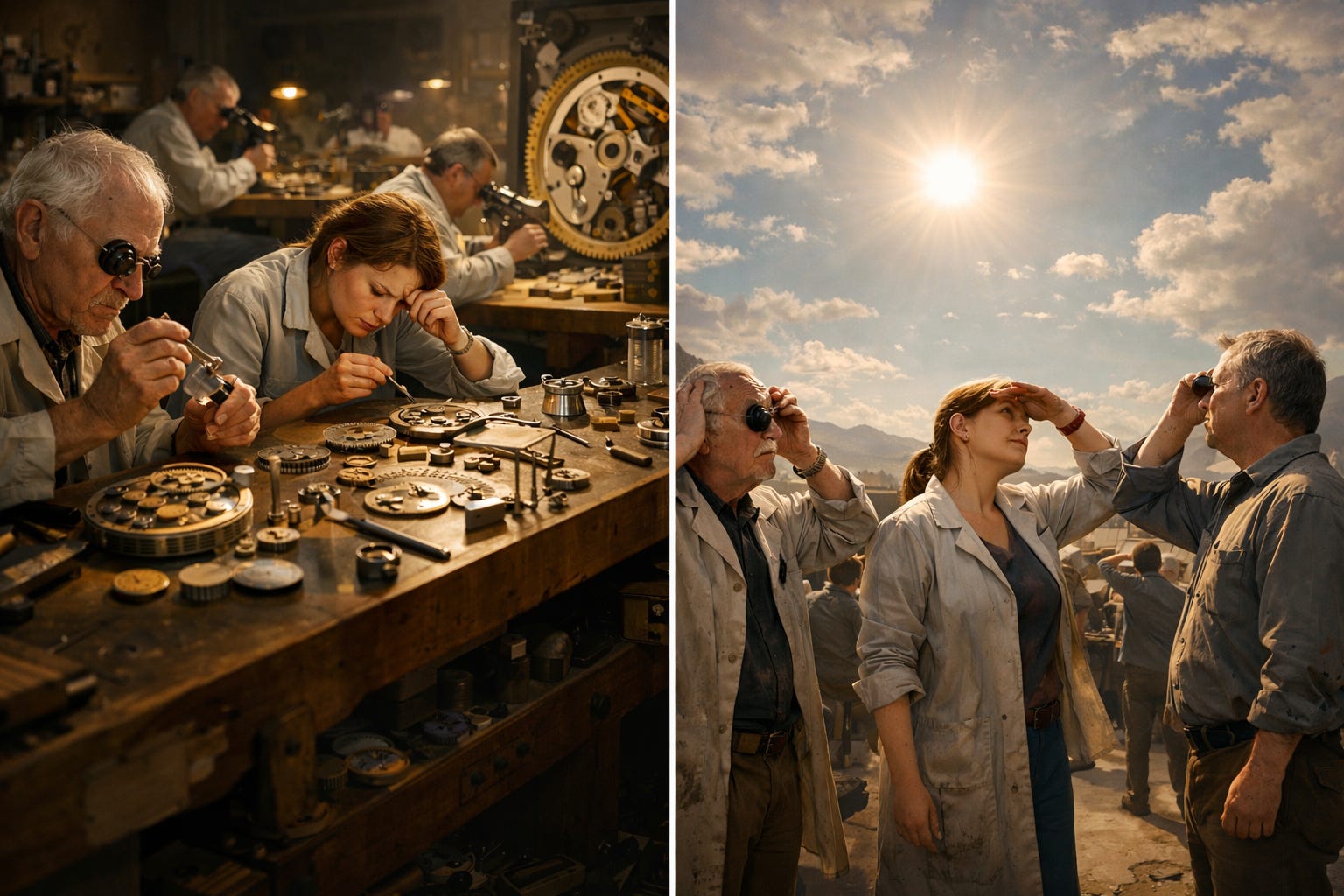
Imagine a society where everyone is trained to manufacture perfect components of a Swiss watch. Each person masters a tiny part with extraordinary precision. The system works beautifully as long as the factory runs.
But step outside, look up, and ask a simple question: what time is it?
Few would know how to answer by reading the sun.
It is specialization doing exactly what it was designed to do: pulling us deep while narrowing the scope. That narrowing is why broadly shared skills quietly disappear. Such as growing food, cooking from raw ingredients, repairing objects, building simple structures or even maintaining one’s physical condition through movement and manual effort.
The paradox is this:
People become extremely capable in narrow domains, while becoming increasingly helpless in tasks that were once common knowledge.
Freedom appears intact, income is earned, choices exist, markets are full, yet basic competence erodes in the background. Dependency grows not through force, but through specialization.
The question isn’t dependence versus total freedom. What matters is how much practical range a person retains within that dependence, and whether it leaves room to maneuver.
Some skills require massive infrastructure to function, like power grids, supply chains, institutional backing. Others work with basic tools, shared effort, and direct knowledge. The difference isn’t just technical. It shapes what remains possible when systems shift or fail.
When this difference goes unnoticed long enough, dependency stops feeling like dependency at all. It just becomes normal.
Skill loss is not a consequence of being restricted. It is the quiet erosion of capacity that makes leaving unrealistic. When essential abilities are outsourced for long enough, people may remain legally free yet practically unable to function outside the systems that support them. Freedom persists as a formal condition, while competence becomes increasingly conditional. No coercion is required. Convenience, specialization, and institutional efficiency quietly narrow capacity until constraint no longer needs to be imposed.
Take a popular and respected profession like a programmer. Someone who is excellent at solving digital problems. They know programming languages, understand complex systems, and can navigate abstract structures with precision. Inside the digital world, this competence is very real. It produces results, status, and income.
For a long time, this work happened in offices. Today, many of those workstations have moved into homes. The location changed, but the structure did not. The work still feeds large digital systems that depend on constant input, turning the home into a workstation within an invisible factory.
Mastering such a narrow and powerful skill can create a strong sense of security in a highly digitized world. Inside that system, the person functions well. Outside it, in the physical world where things grow, decay, break, and need care, that same competence often does not translate.
Bodies, materials, and living processes don’t respond to commands, updates, or abstractions. Most of those require a different kind of engagement: slower, hands-on, and personal.
Freedom stops looking like escape or independence and starts looking like retained range. The question is no longer “How do I leave the system?”
but “What capacities am I quietly losing while functioning inside it?”
Sovereignty begins to resemble navigation rather than resistance.
If the systems you rely on simply paused, what would you still know how to do?