

The realization of starting to see the farm or the control mechanisms of the world can happen in different ways. Sometimes it comes spontaneously. Other times it unfolds gradually, by moving through deeper layers, like we have done in these articles. For some, the shift happens suddenly. For others, it progresses step by step.
When the understanding goes deep enough to shatter core beliefs, an inner knowing or gut feeling begins to form. It creates the need to find one’s own truth, one’s own framework to live by. At that point, questions appear that are difficult to ignore. Why are we here at all, beyond feeding an economic or administrative machine? And if the game is already set, how do we optimize our experience within it?
What follows is pattern recognition. By gradually reviewing lived experiences and seeing them again in present-day life, the dots begin to connect. Situations that once felt isolated start to resemble each other. You notice repetitions. Familiar dynamics appear in different forms.
As this recognition grows, patterns become easier to see. But it is no longer only about observing and becoming more aware. You also go deep into rabbit holes to research what others have already found about human existence. You read, listen, compare, and study. In the end, you want to anchor your conviction somewhere, at least for yourself. You want a reference point.
That anchor can be based on feelings and lived experience, but at least partially it needs to be grounded in information in a more traditional sense. And this is where things become tricky.
Information can be outdated. It can be repurposed, compromised, biased, or contradictory. So you search for more. Over time, instead of clarity, you discover that the problem is not a lack of information at all. There is overwhelmingly and disturbingly too much of it.
Opposing views stretch toward every extreme, all claiming to be the absolute truth. They draw on experience, research, ancient wisdom, personal testimony, or science. Learning under these conditions can become a multi-year process, often accompanied by the feeling that your truth is like sand slipping through your fingers.
At that point, confusion no longer comes from ignorance. It comes from overload, and from the slow erosion of any stable place to stand.
If we look at this through a farming perspective, animals raised in industrial farming systems are not deprived of food. They receive all the nutrients and ingredients experts believe are necessary for an average animal, often even more.
At the same time, we do not really know what, how much, or when an animal would choose to eat in nature. What we do know is what experts consider sufficient, based on books, measurements, and standardized models.
In practice, the system often prefers to overfeed animals and humans rather than keep them hungry. Overfeeding is safer. It is more predictable. It is easier to manage.
Something similar happens with information. Just as farmed animals no longer eat what they would naturally choose, information consumers no longer select what they naturally need. Instead, information becomes standardized, blurred, processed, and excessive.
The information overflow we consume resembles processed food and animal feed. It is difficult to digest. In the long term, processed diets lead to metabolic and physical disorders. The same pattern applies to information. Being overfed with industrially processed information through news, education, social media, belief systems, and even academia puts the mind under constant strain. It affects thinking patterns, worldviews, and mental balance first. Sooner or later, the body follows.
There is no lack of input. There is too much of it.
And just as farmed animals are conditioned to follow rather than choose, chronic overfeeding of information produces decision fatigue. The overwhelm itself trains people to stop filtering and start following what is easiest, loudest, or already selected.
In the case of information, the effects of overfeeding show up in the mind. Confusion. Imbalance. A growing loss of orientation and of a stable place to stand.
The question quietly shifts from what is true to what helps restore orientation, and how we base our beliefs accordingly.
Most people try to anchor at the intersection of their own experience and trusted sources they followed for a long time. Such as parents, peers, practitioners, thinkers, scientists who have proven reliable over time.
But almost every solid anchor can be questioned if we remain open-minded. Even science can be compromised. Whoever funds research can influence outcomes or shape the narrative of how results are presented. As trust in mainstream understanding erodes, people turn toward alternative sources.
Yet not all alternatives are trustworthy either. Many operate within the same market economy, driven by similar incentives as the conventional, only wearing different language or positioning themselves as oppositional.
So the problem is neither a lack of information nor a lack of access.
The problem is the gradual loss of a reliable filtering capacity. Patience, ambiguity tolerance, and slow sense-making weaken. Interpretation itself becomes outsourced. In an environment of constant information feeding, filtering capacity is not exercised. It slowly fades, not through force, but through disuse.
When people lose trust in mainstream beliefs, understandings, or knowledge, they often turn toward alternatives. But alternatives are not automatically better. Some are controlled opposites of the mainstream. Others promise complete systems, full methods, or final answers. Shiny solutions. Free beer and eternal life promises.
The search itself often follows a familiar pattern. You look for clarity, latch onto an explanation that feels complete and emotionally satisfying, and settle for a while. It brings relief. It creates a sense of orientation. Over time, doubts reappear. Inconsistencies surface. The explanation stops working. So the search begins again. We are conditioned to want instant answers instead of composing our own. Sitting with uncertainty feels uncomfortable, especially after long periods of confusion. When answers feel complete and reassuring, it becomes easy to follow a guru or an ideology rather than remain in that uncertainty.
Think of information again as animal feed. It is measured, developed, adjusted, and researched over long periods of time. Not only to nourish, but to ensure acceptance and regular consumption. Predictable feeding creates predictable behavior. Over time, certainty and repetition rewire responses. A kind of Pavlovian reflex forms.
Even grazing or wild animals will travel long distances and line up at feeding stations once they learn where and when food reliably appears. They stop grazing, hunting, or gathering on their own. Not because they are forced to, but because the system makes following easier than choosing.
Something similar happens with meaning. Belief, faith, and identity carry enormous energy. That energy can be mobilized, redirected, and used. Often this happens quietly, without the person noticing how much of their orientation has been outsourced. This is the energy that leaders and gurus use and often misuse.
Gurus are just people. Within each person there are good traits and less good actions. Yet when interpretation is handed over, what is being followed is no longer just a person or an idea, but the relief that comes from no longer having to filter, decide, or hold uncertainty alone.
At some point, developing one’s own belief system becomes unavoidable. Not as an absolute truth. Not as something to impose on others. More like a walking stick, something to rely on while moving. This requires a certain discipline. The discipline of not needing complete answers all the time. Because the moment total certainty becomes necessary, vulnerability increases. That is often when people get converted into an “ism.”
This article series is not meant to provide prepackaged answers. Those can be shiny and satisfying for a moment. The intention is to support the search for an intersection: what you experience yourself, what others you trust have experienced, and what continues to hold up over time in lived practice.
Being fully confident can feel powerful. But in nature, in life, and in the human mind, rigid systems tend to break under pressure. A small degree of uncertainty can be a form of strength. It allows flexibility. It preserves the ability to adjust, to move on mentally when conditions change.
In that sense, uncertainty is not a failure of understanding. It is part of maintaining orientation.
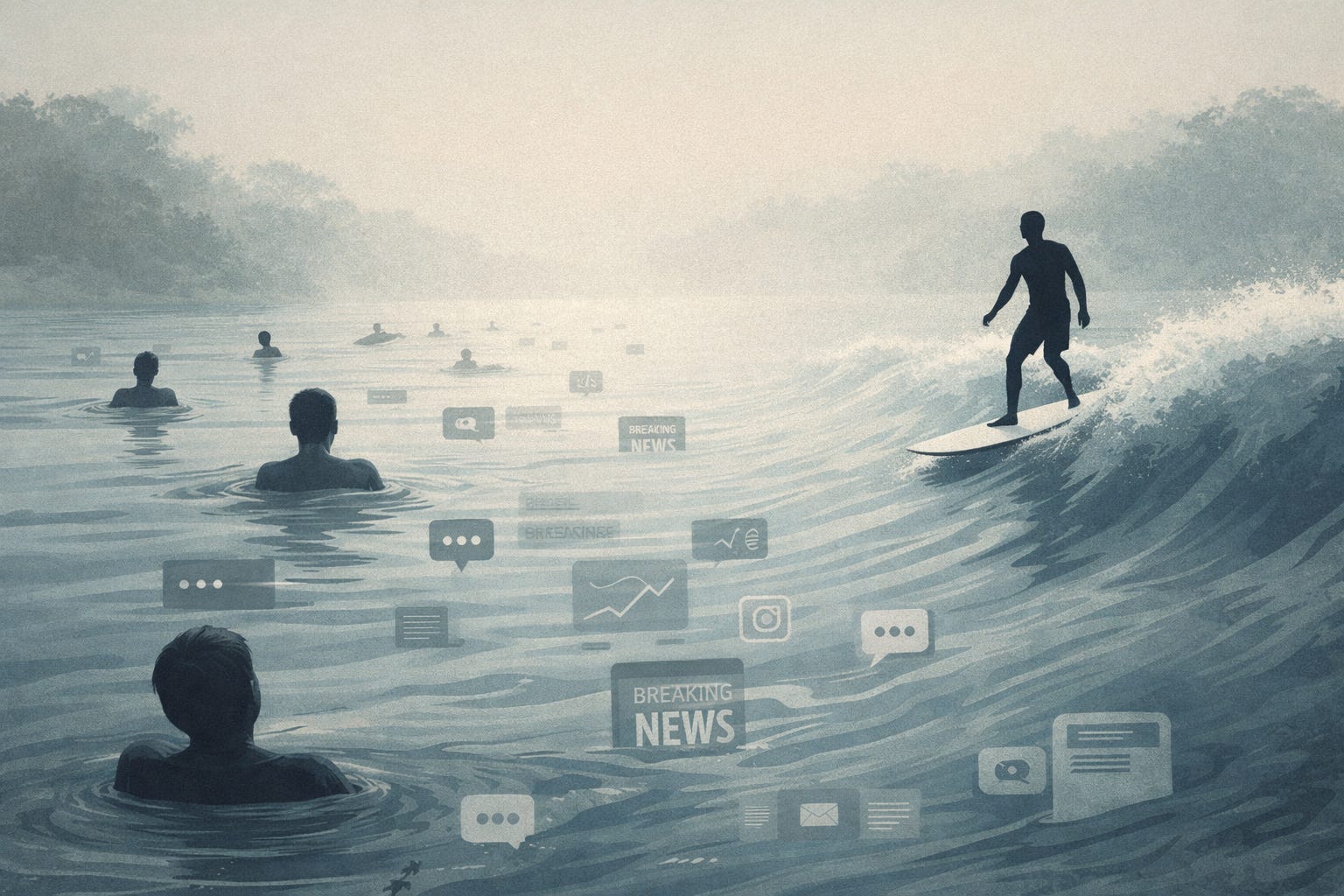
There is an image of life as a river, or a conveyor belt. Many things are set. The movement continues anyway. Once you realize you are in it, the ride can unfold in different ways. It can be unconscious, like sliding down a giant slide with eyes closed, screaming now and then. Or it can be more like surfing. The wave still moves forward, but awareness and coordination change the experience. Being conscious can be terrifying. But it can also feel more alive than being constantly dragged or steered by forces you never see.
Are you sliding, or are you surfing in life?