

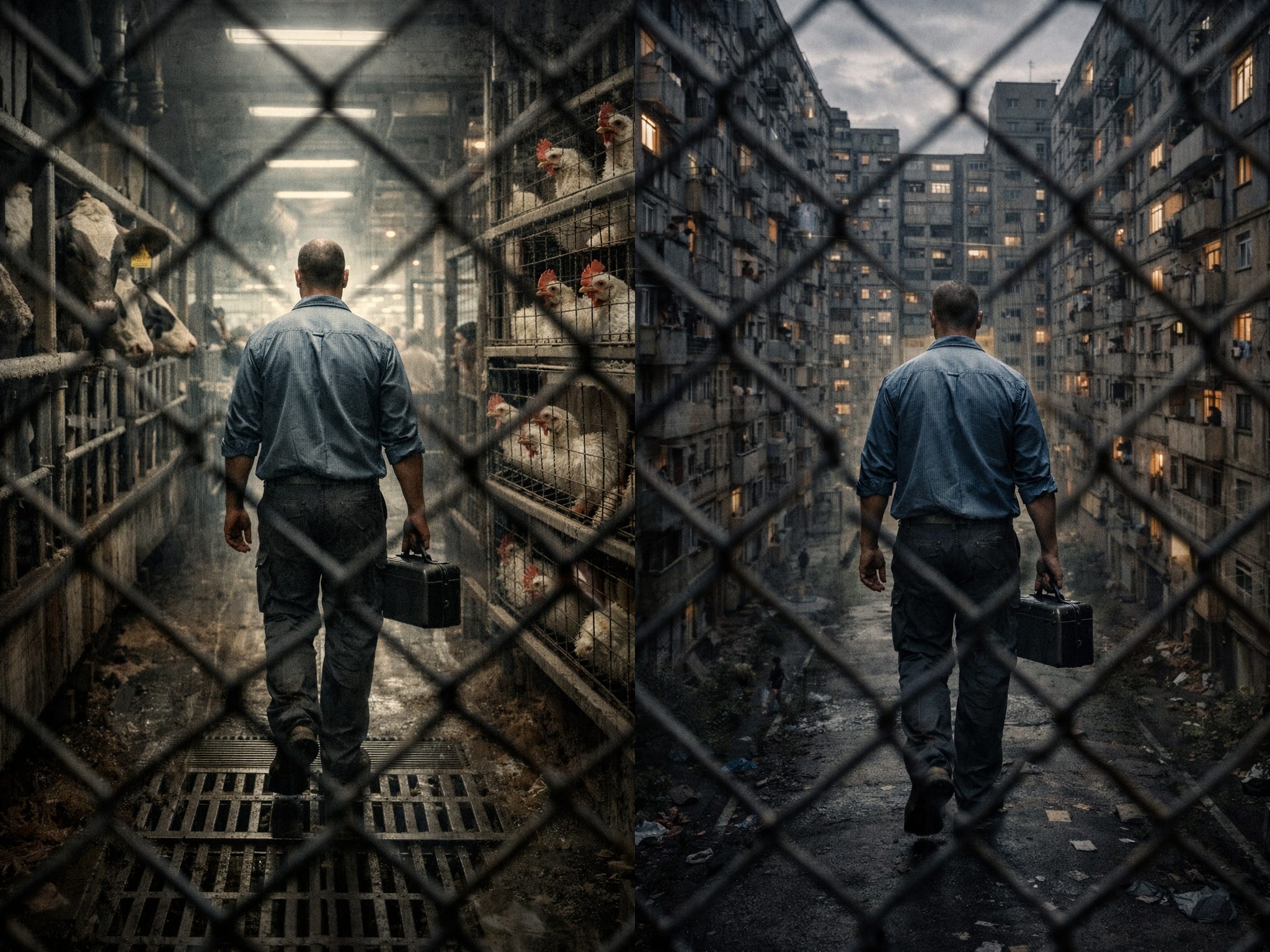
As I told you through the farming metaphor, I was trying to highlight that it is not the farm that is the real problem. The farm can be seen as the frame in our life: routine, rules, and give-and-take dynamics.
I think the real problem is not being aware of the farm mechanism itself.
Most people who hear about the “farmed human” idea will immediately think about buildings and structured physical confinement.
And that is partially true. Apartment complexes, warehouses, factories, and offices are often designed in a caged, artificial, farm-like way.
Even knowledge institutions sometimes reuse almost the same architectural design as prisons. So the physical, built dimension shows itself bluntly right in our faces.
But that alone does not explain why people burn out, why corporate austerity management and toxic work environments tend to feed themselves like a perpetual Frankenstein. These systems eat up people’s souls and health and then “recruit new talents” to replace the broken ones. With this, they normalize harmful practices rather than redesign human resources to create real teams and liveable work environments.
Let’s leave factories and corporate offices for a moment. If we look at farmers themselves, statistics show that at every level - from small-scale operations to large farms - they are pulled into the same burnout-driven farming funnel that they operate within. Financial insecurity, risk management, and isolation lead to insomnia, substance abuse (mainly alcohol), and even suicide. There is no dystopian office tower or Amazon warehouse here. Farmers work in wide open spaces with fewer human interactions, yet similar problems prevail.
Now let’s flip the script and consider those who appear to be mastering life as independent creators or lifestyle entrepreneurs. I originally intended to present them as examples of freedom. However, even van-lifers and adventurers are struggling either because of the initial hustle and being glued too much to the screens or after achieving some level of success burn out or just develop an impostor syndrome. Honestly it could feel pretty weird, constantly hanging on Instagram, posting all kinds of stuff and trying to come up with next algorithm-breaking trend. For me the patterns of the mind farming on social media are so vivid that it really freaks me out.
I’m not making this up - look into it yourself. But let’s acknowledge that smoothly functioning human conditions receive far less attention and research so mainly the terrifying or utopistic sugar coated stuff is documented. My intention was only to show that the farm mechanism is human-invented and maintained process. It serves us to a certain extent, but it can threaten, negatively influence, or even swallow any of us. Weird routines, meaninglessness, over or under-stimulation, and identity or health crises can reach anybody.
So far, I have described environmental factors: built, social, corporate, and institutional, all operating at different levels. Across industries and across every rung of the success ladder, dissatisfaction, frustration, and exhaustion or burnout can take hold.
Now, let’s zoom in to the actual “vibe frequency” the internal signals that show we are not in the right place.
I don’t know about you but whenever I felt extreme discomfort in a working situation, I felt a sense of being captured, forced to act against my will. The metaphor emerged instantly: feelings similar to what a horse might experience when being broken in, or cattle being captured and placed in a yoke.
In ideal conditions, pets and draft animals are rewarded for accepting the new deal - but the balance must be maintained. Too much spoiling or too much punishment is harmful for both humans and animals’ general wellbeing and productivity as well.
And just as it is an art to become a great animal trainer, to become a manager to manage others requires comparable attention, care, love, patience and all this starts with self-knowledge.
Knowing ourselves deeper would save us, our coworkers and our employers from unnecessary disappointment, misalignment and conflict. Yet the journey is not straightforward. Bad choices often teach us more than taking the paved road. Unfortunately, the social, technological, administrative, and institutional vortex we enter when we join the labour market leaves limited space for real self-exploration. And this vortex is always evolving leaving us constantly feeling left behind. As a result, the initial building blocks of our identity and career become distorted, and all other layers deform. This might explain why many managers, farmers, and even solopreneurs “suck,” and making their own and others’ lives miserable.
Wow. I got philosophical here.
But I realized that confinement begins at the psychic level, shaped by our socioeconomic environment, learned patterns of compliance, and subtle, often unspoken expectations.
Where do you feel most confined without ever calling it confinement?