

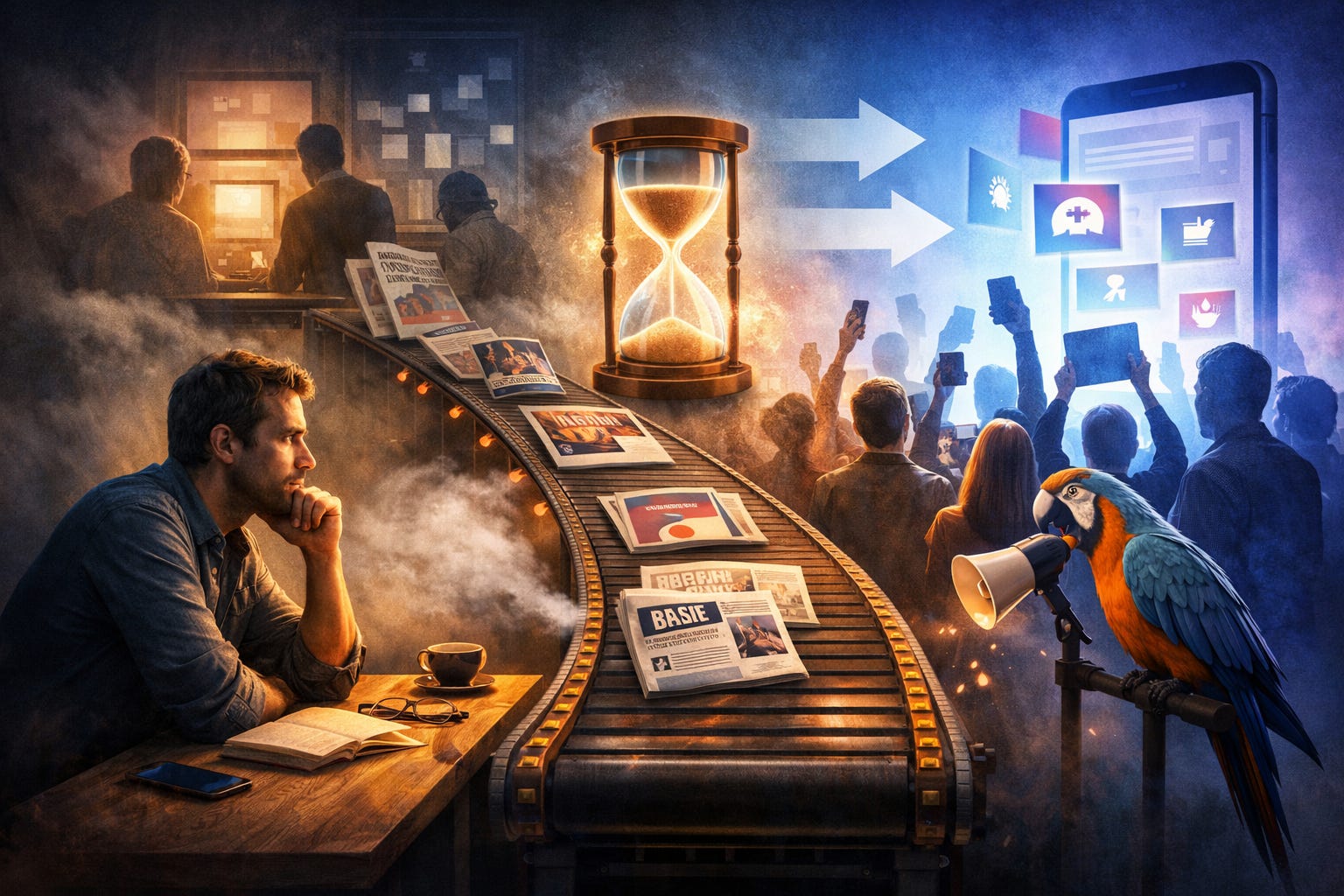
Election cycles have a way of revealing people.
Some encounters are predictable. You meet someone who cannot separate themselves from their political alignment. The frustration is visible. The need to signal allegiance is immediate. The conversation narrows before it even begins.
But the more unsettling encounters are quieter.
You meet someone thoughtful. You talk about work, ideas, life. They listen. They respond. They seem capable of nuance. Politics does not dominate the exchange, and you leave with the impression that this is someone who thinks independently.
Then you see what they post online.
No added context. No personal framing. Just a repost. An article. A documentary clip. A headline circulating widely. The tone is certain. The framing is clear. The nuance is gone.
The person in front of you and the account on your screen do not quite match.
A repost is not merely a sharing mechanism. It is also a simplified, accelerated statement of position, without the trouble of having to formulate your own.
When someone writes their own interpretation, their reasoning becomes visible. It can be questioned, refined, or even contradicted. A re-post transmits the same political alignment, but the argument and its origin come from elsewhere. The emotional charge, however, is immediate.
This directs attention straight to the emotionally triggering nature of the content itself.
Much of the political material circulating during election cycles is not designed for nuance. It is designed to land clearly and quickly. The framing is decisive. The language is sharpened. Complexity is compressed. Simply because clarity and emotional certainty travel farther than a more layered exploration of truth.
Under these conditions, amplification happens almost effortlessly.
As more of this material circulates, the range of acceptable interpretations narrows. Conversations begin at a higher emotional temperature. Positions harden before dialogue even starts.
The real-life contrast thus becomes less about different types of people and more about a shared behavioral pattern. The openly frustrated and the seemingly thoughtful may differ in tone, but both can end up redistributing narratives and opinions that were designed and written elsewhere.
The mechanism is the same. The only difference is whether it happens in person or online.
The content does not produce itself.
Political media content creation is a large-scale professional industry. The articles, videos, and documentaries circulating during election cycles are produced by organizations that operate with funding, staff, distribution strategies, and performance metrics. These are not spontaneous civic outbursts. They are the result of manufacturing within a highly competitive attention economy.
And like any professional content in the online space, they are optimized.
Some reassure and reinforce what a given audience already believes. Others mobilize: they provoke a strong enough reaction to guarantee debate or outrage. The method differs, but the underlying logic is the same.
Independent analysis introduces friction. Nuance slows distribution. Acknowledging complexity does not travel as efficiently as the assertion of “certainty.”
This is where the structural tension appears.
Democracy, by its very design, requires opposition. Competing interests must coexist within the same system. Disagreement, rivalry, and debate are not flaws — they are built-in features of the system.
However, when both sides industrially present the other as an existential threat, the mechanism begins to distort. Opposing sides cease to be competing players and become adversaries seeking the other’s final defeat or even elimination.
If democracy is a bird, it needs two wings. Both belong to the same body. Lift is generated only through coordinated tension.
When both wings are conditioned to view the other as illegitimate, the organism does not stabilize. On the contrary, it destabilizes.
This is mostly the consequence of the built-in incentive system. Where amplification is the reward, division will eventually be amplified.
Modern democracy does not require constant political performance from citizens.
It requires participation at specific moments: going to vote, discussing issues at the table with people you actually know, and reaching conclusions through genuine exchange rather than pre-adopted positions.
That would be a truly democratic process operating within a framework.
What disrupts it or slowly makes it impossible is not the complete absence of agreement. It is the continuous circulation of industrially produced content and the associated opinions by citizens themselves, both in conversation and online. These materials were never designed to create consensus. They were designed to trigger strong, often hostile emotional reactions.
These two things are not the same, and confusing them has consequences.
The practical question is whether we can somehow break this reflex.
A simple self-discipline exercise: before sharing, pause and examine how a story is framed. With most press products, it quickly becomes clear which political direction it leans toward. Once you see that, it becomes easier to ask: what might have been left out of this story, and how does the same news look in other sources?
If you are unsure about the source of an article or video, or simply want a clearer picture of how the news industry works, you don’t necessarily need lengthy research. Tools like Ground News show how the same story appears across different outlets and who is covering it at all. These tools do not tell you what conclusion to reach. They make the structure of the narrative visible so that your reaction is no longer a pure reflex, but a conscious choice.
The deeper question, however, concerns those capable of nuanced thinking. Those who can conduct layered conversations in person, who recognize complexity, and who understand that reality rarely fits into simple frames.
Why does this voice so often remain confined to private conversations? Why does the pre-packaged news and its ready-made explanation travel much farther than thoughtful analysis?
When formulating your own thoughts requires real mental effort, while forwarding industrial news requires nothing, at most a single click, real influence quietly concentrates at higher levels.
A relatively small number of institutions and content creators shape the framing and presentation of political issues. A much larger number of individuals simply redistribute those frames. This asymmetry is not accidental — this is how attention markets function at scale.
It also means that much of what circulates as political opinion was actually born elsewhere: in a specific editorial or strategic context. And in the end, it is this pre-formed content that reaches people for interpretation or redistribution.
Not as victims of the system, but as participants in it.
One share takes one second. Formulating your own position takes more time. A momentary pause to examine the framing just a little more.
None of these are dramatic steps. Yet structurally, they are different.
So the question is not which side is right.
It is this:
Is the position you are about to pass on truly your own?