

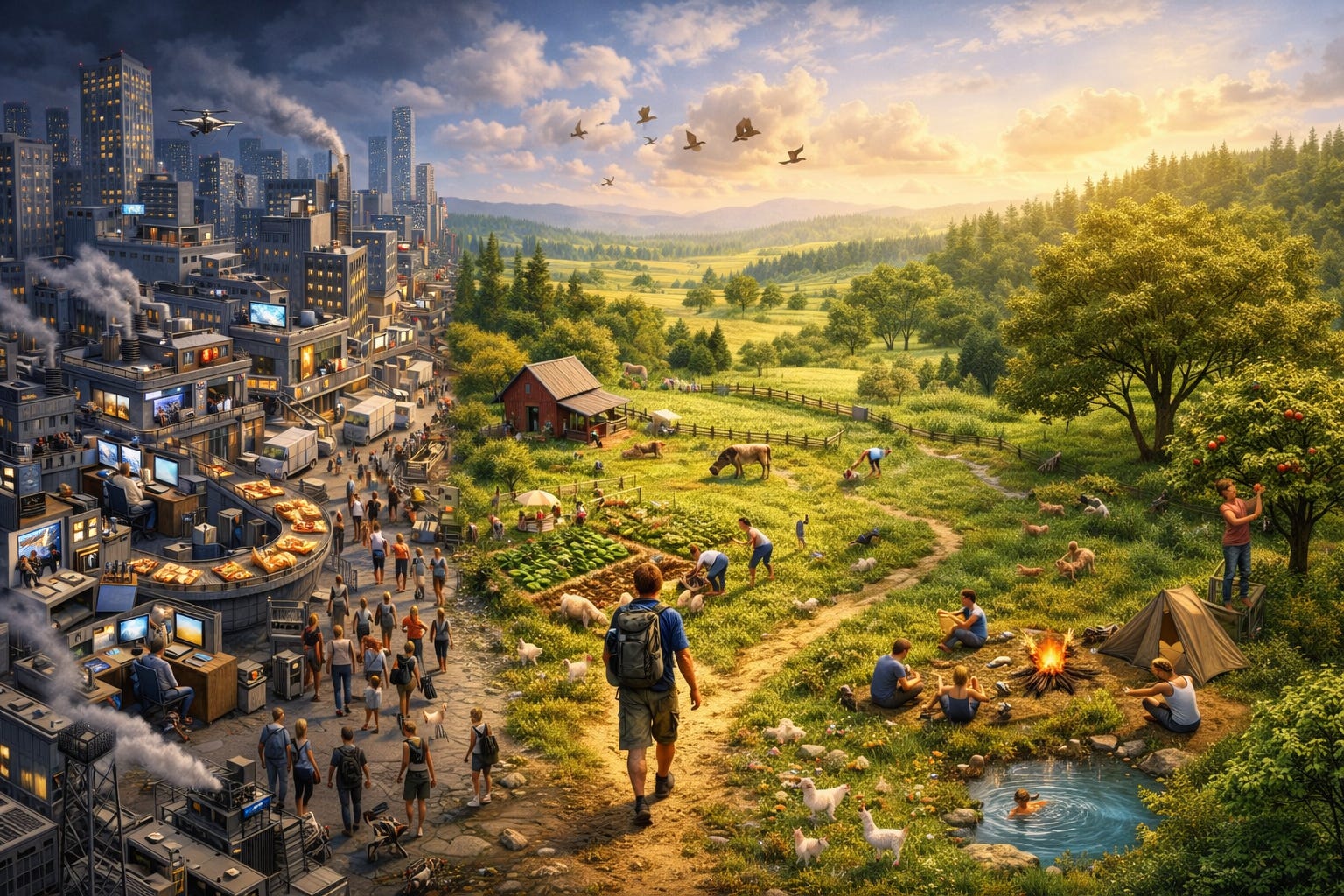
Trying to write about the Free-Range Human concept towards the end of 2025 is a real struggle. The news has been parroting for years that the world is falling apart, but despite this sh*tstorm I still feel I have something to say that might be disturbing at first but along the way can provide grounding in this hypervigilant world.
So the struggle is to find an entry point: where to start the storyline, and how to frame a concept, a worldview that has been developing in my psyche for almost a decade. At first, I thought it was a nice concept to share at the beginning of my new project, The Outside Thinker. Then I started to collect my notes and insights.
I had to split an older unused intro article to create an about section for The Outside Thinker – TOT (see about here). In that text, the concept of the free-range human was already going wild. After this split, it showed itself as a potential blog series at first glance. A series of episodes almost naturally appeared from start to finish: a build-up, supporting evidence, stories, insights, and a conclusion.
But the definite structuring of a closed-ended storyline just shifted to six and then seven possible episodes until I found an almost forgotten, unfinished article about (surprise 😊) the Free-Range Human from a year ago, which was already reaching the staggering word count of 4000 words.
So let’s attempt to go further with a list of some basic concepts just to somehow circumnavigate the idea of the Free-Range Human. (It is your task to re-educate yourself if some of these otherwise fundamental concepts might get blurred in your mind or in your surroundings 😉)
Human being, instinct, reward mechanism, comfort, intellect, agriculture, agricultural revolution, farming, livestock, slavery, exploitation, civilization, society, government, corporation, citizen, autocracy, democracy, self-reliance, sovereignty.
Even if you do not head right away to search Google, Wikipedia, or use the help of AI, you can directly see that a big chunk of the list is closely related to agriculture.
Because honestly, agriculture is the backbone of where we are and how we live today. We can try to deny it, come up with other seemingly more important concepts and practices, but at the end of the day -or even earlier- you want to open the fridge and see what there is to eat.
Through food and other materials, we are directly and indirectly engaged in agricultural activities for a long, long time. Agriculture is the broader framework that includes the actual operational process of farming. And my observation here is: isn’t it possible that throughout the practice of farming for centuries and millennia, we are also being farmed? We have been told that we are on the top of the food chain but similar principles and similar practices are applied on us to harvest our energy and life force.
From a bird eye- perspective, we can see more clearly that we are confined in limited spaces, quite often very much so. And basically, technology and complex supply chain systems are taking care of us at almost every corner of life -this is true even if we just strictly focus on food, let alone all the other goods and gadgets.
We can call it comfort; we can call it modern, but in essence the switch has to be on and the plug plugged in to keep everything “comfortably” going. And the nurturing “tits” on our end of the supply chain are not abundant, endless flows of resources we have access to. There is always an exchange involved. We can call it a purchase; we can see it as a very modern, high-tech way of securing our access to food. Like magic, we just offer some of our digitally stored invisible savings, and the transaction is done.
But to be very honest: for your “digital” resources (unless you inherited a lot or are a trust-fund kid) you had to deliver something, give something, sacrifice your time and energy at work.
So even if it seems totally abstract by now, the general exchange of freedom for being fed and exploited like livestock has actually happened.
To make the comparison even stronger: a modern human avoiding the farming process would face challenges trying to survive in nature. In many ways, it mirrors the struggle of a domesticated animal that suddenly breaks free.
Indigenous people and wild animals have the skills to not engage with the farm, but domesticated animals and modern humans don’t.
I believe that recognizing the farm as an invisible mechanism woven into almost every detail of our life can help us navigate it better. At the same time, I also admit that it can be scary to look at the world this way. But as human conditions vary across continents, countries, cities and neighbourhoods, so does the approach to farming: the main principles are the same, but the lived experience is vastly different. The spectrum between factory farming and free-range conditions is huge.
Hence, I came up with the concept: The Free-Range Human, which is more an adaptive attitude and experiment than any specific method, quick fix, or instant relief.
A Free-Range Human is a person who lives inside the system without becoming fully domesticated by it, much like a free-range chicken that still lives on the farm but moves more freely, stays closer to nature, and retains more of its natural behavior.
There are really harsh human conditions that resemble factory farming far more than others. There are almost infinite variations and grades of being farmed. On the other end of this spectrum, it can be hard to pinpoint where human freedom is being compromised because some are able to thrive and achieve a so-called work–life balance. Finding someone’s real calling, a vocation where life turns into a meaningful mission or art piece while being in flow, is the ultimate self-realization. If someone is able to reach that, the farm metaphor of exploitation and trade becomes obsolete.
After reading this article, which part of your life feels most “farmed,” and which feels most free?