

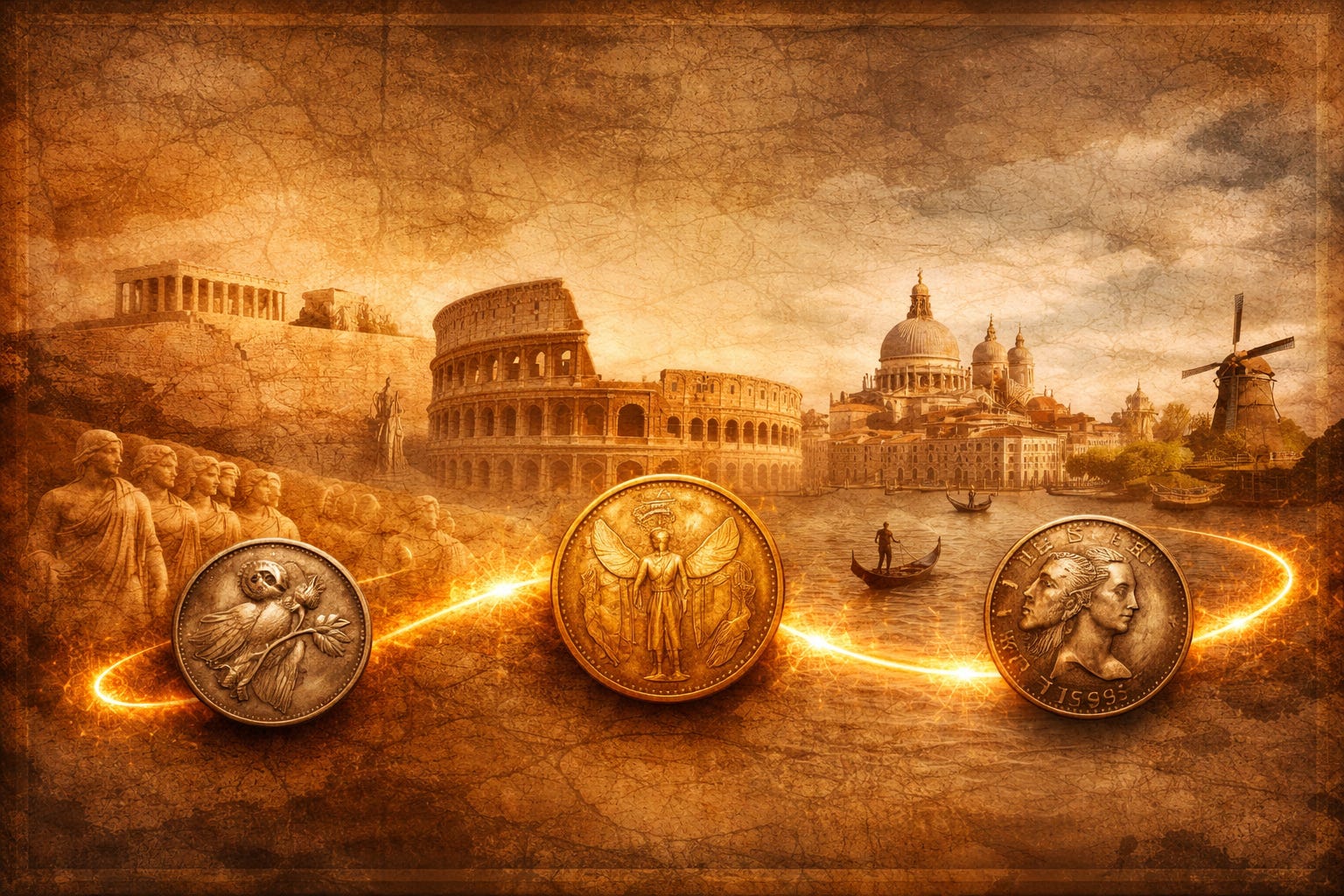
The frustration returns every two years.
I wrote about it in the first two articles: election cycles, polarization, careless social media sharing, and tribal noise. It became clear early on that we rarely discuss the origins of democracy or how suitable the original concept actually is as the foundation for modern democratic systems.
This is not just an American phenomenon. The same pattern repeats in Hungary and internationally.
So I wanted to understand the source: what really lies behind these recurring conflicts? What exactly is this thing we call democracy, and what produces this cycle that keeps returning?
But I didn’t want to stop at its origins or examine it merely as a mechanism. We already touched on that in the first two pieces. What I wanted to know was whether there existed some kind of historical bridge that carried similar ideas from Athens all the way to the present day.
Because if we simply lifted a 2,500-year-old concept and transplanted it into the modern world, that is one story. But if the mechanism actually survived, adapted, and continued to evolve through different political forms across the centuries, that tells a very different story.
One pillar of that bridge gradually became clear. Living in the Netherlands, the Dutch Republic frequently appears as one of the most innovative governing systems of its time. It is also often cited as a direct predecessor of the United States, which itself began as a republic.
Then I stumbled upon studies of the Venetian Republic. There too I found governing mechanisms and institutions that strikingly resemble those in today’s democratic systems.
At that point the arc of the bridge already spanned more than a thousand years.
And as that arc slowly coalesced into a continuous bridge, something became visible:
Between the two bridgeheads, ancient Athenian democracy and modern mass democracy, stood republics the entire way.
The Roman Republic.
The Venetian Republic.
The Dutch Republic.
The American Republic.
These were the carriers. The mechanism never fully disappeared. It lived on in different forms, under different names, serving different interests.
If you follow that thread through the history of these republics and how their systems evolved, the modern democratic system appears in a completely different light.
That is what this article is about.
Looking carefully at this “bridge” may also give us a clearer picture of our present situation.
The familiar narrative presents democracy and republican governance as the triumphant result of human progress: enlightened thinkers, hard-won freedoms, the gradual realization that people have the right to a voice in how they are governed.
This story is not entirely false. But it is incomplete in one important respect.
Let’s look at where these systems actually emerged.
Athens was not merely a philosophical experiment. It was a maritime trading power, financed by silver mines and sustained by merchant networks stretching across the Aegean.
The Venetian Republic was built entirely on commerce. Its governing structures were not created to express an ideal, but to protect and regulate trade routes.
The Roman Republic began as a city-state in which trade and the economic interests of senatorial elites shaped the early institutions, long before imperial expansion.
The Dutch Republic grew out of merchant federations that needed a stable, distributed power structure for global operations.
The United States, too, began as a commercial republic, seeking liberation from British trade restrictions at least as much as from political tyranny.
The pattern is consistent. Wherever republican or proto-democratic governance appeared, we find an economy built on trade — one that required predictable rules, distributed decision-making, and protection from the arbitrary, centralized power of a single ruler.
This was not primarily about human-centeredness. It was the need for market stabilization, dressed in the language of political philosophy.
There is another striking detail: these republics mostly did not arise in the heart of great land empires, but on their edges or in the spaces between them.
Venice in its lagoon. The Dutch in their league of trading cities. These were flexible, commerce-based systems that relied on a different kind of power — not territorial conquest, but trade and institutional stability. Precisely this made them resilient and allowed them to become the carriers of the mechanism.
Democracy and republic are two concepts whose meanings often blur together in public discourse. Yet they do not mean the same thing, and this distinction is more important than it first appears. We will examine it in more detail in the next article.
All the republics listed followed a similar pattern. They emerged where commerce demanded stable rules. Over time they gradually refined their governing mechanisms. Yet their own success and growth eventually created a scale that the system found increasingly difficult to manage. The accumulated tensions eventually wore them down.
Athens operated a naval trading empire with direct citizen participation. Imperial overreach and internal conflicts eventually tore it apart.
The Roman Republic developed the model further through the Senate, consuls, and institutions designed to limit power. But scale consumed it; the very empire it built caused the republic’s downfall.
The mechanism, however, survived. The Byzantine Empire preserved Roman law and administrative traditions for centuries, passing on institutional memory.
Venice revived the system as a merchant oligarchy with a sophisticated multi-layered council structure. This grew directly out of its long history as a Byzantine province and duchy, centuries before it achieved full independence.
The Dutch Republic eventually began to fracture under rivalries between the provinces until the federation broke apart.
The United States created the most advanced version so far. Today, however, it struggles with the same familiar pressure: scale. A system designed for coherent communities has difficulty holding together a vast, divided continental nation.
The system still holds for now. But the pattern is clearly visible.
All the republics mentioned were built on commercial and power structures. The human-centered language appeared later, with the arrival of modern mass democracies. In practice, the earlier republics were shaped by the interests of commercial and financial elites. This is a well-documented historical fact.
From here follows a question that history has still not answered: what would a truly human-centered democracy actually look like?
Not one that promises — on ideological, almost altruistic grounds — to serve the people, while in practice protecting the stable operation of commercial power structures. Not one that mobilizes emotions every few years to grant legitimacy to decisions made elsewhere.
But one in which citizens’ capacity for thinking, debating, and forming considered judgments constitutes the core of the system — not merely its decorative surface.
Historical experience suggests that such an experiment has never been fully attempted. Athens came closest in theory, yet excluded the majority of its population. Later republics openly prioritized the interests of commercial and financial elites. Modern mass democracy adopted the ideological rhetoric, but never created the intellectual and institutional conditions required to make it real.
Two changes would be necessary. Citizens would need to approach political questions with the same seriousness they bring to the major decisions of their personal lives. Institutions, in turn, would need to reward sustained, thoughtful deliberation rather than emotional waves.
The structure and mechanism of proto-democracy and republican governance have stubbornly persisted for more than 2,500 years, continuously adapting. Empires rose and collapsed around it. Yet modern mass democracy has still not carried out one single experiment: to take seriously the ideology it constantly invokes.
If multi-million-person countries and unions of hundreds of millions build their legitimacy on these principles, the real question is whether they are capable of placing those principles above economic and power interests. History so far suggests that when economic cycles and the movement of capital strongly reshape the system, the stability of republics and democracies is shaken as well.
I tried hard to genuinely understand what is actually happening. I traced the development of today’s democracy back to its beginnings and found something less dramatic than I had expected. Not a broken ideal, but a mechanism with a long history, clear limits, and a persistent gap between what it promises and what it actually delivers.
That gap is not a reason to reject the system. It is a reason to understand it. Democracy then appears less like a sacred idea and more like an operating structure that has been continuously adjusted, stretched, and sometimes broken over more than two thousand years.
Seen this way, the conflicts become almost self-evident.