

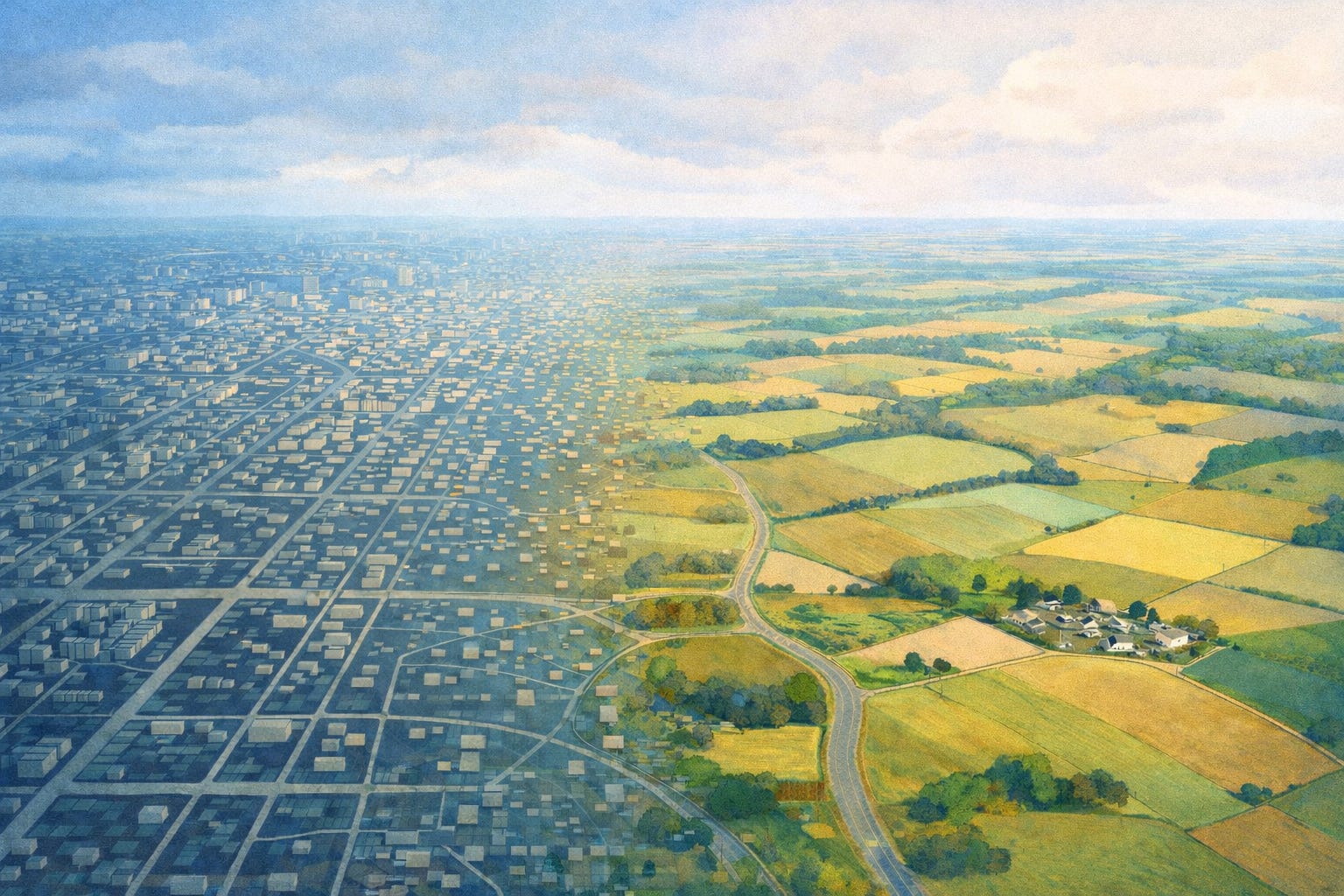
The tribal war, for me, is almost always on.
In case you missed it: 2026 is a parliamentary election year in Hungary. As a Hungarian who tries to stay reasonably informed through international news, I notice that the Hungarian and US electoral cycles follow each other closely. When one wraps up, the next one’s buildup starts right away.
From where I stand, that leads to a near-permanent two-year rotation of political intensity.
The election atmosphere always creeps in through trending posts and videos. These days, it just feels exhausting and nauseating.
I admit I’m probably more analytical and more sensitive, than most people.
Yet what still baffles me is this: despite the spread of knowledge and the sheer abundance of ‘information’ out there, things seem to get worse every two years.
For more context on how I see the information and news feed being literally fed to us, see my article: 7. The Information Farm
So why don’t we step back and examine how democracy actually emerged in modern times?
It’s a comforting story. But it’s romantic, and even naive to imagine that, after centuries of suffering and injustice, a fairer system simply emerged organically from intellectuals in cafés, purely for humanity’s benefit.
Without understanding the real historical arc, it can almost seem as if, in some elite social club, a charismatic figure simply declared: ‘Let’s revive parliamentary structures and voting, just like the ancient Greek city-states did 2,500 years ago.’
The historical arc that produced this system deserves its own examination, and we will get there in a future article.
But do we really see the gap in time and scale?
And if we do, why does the democratic process feel increasingly hysterical?
Let’s also be honest. Democracy in the Greek city-states was not universal. Women had no voting rights. Slaves had none. Resident foreigners were excluded. The majority of people living under those city-states had no participation in their democracy.
That is the baseline we built on.
The scale was small. The scope of inclusion was limited from the very beginning.
And even within that limited circle, participation was not abstract civic virtue. Political decisions were tightly connected to the economic interests of those who were allowed to take part.
If the Greek city-state is our baseline, small in scale, limited in inclusion, already constrained, then what exactly were we scaling when democracy became a modern governing model?
At its core, democracy functions as an operating system. It exists to distribute power in environments where shared resources and shared spaces require collective management. The moment large numbers of people live in proximity, everything amplifies. Economic decisions, ideological direction, public safety, foreign affairs. In such conditions, governance operates with leverage. A single decision can affect millions.
This is part of why democracy carries emotional weight. It speaks to fairness, to voice, to the idea of participation. That appeal is real. But the emotional narrative and the structural mechanism are not the same thing.
Structurally, democracy organizes the concentration and distribution of decision-making authority. It determines who steers and how steering changes hands. It does not eliminate power. It formalizes it.
And here is the built-in constraint: no city, let alone a nation, can function through millions of direct individual choices. Representation becomes necessary. Leadership concentrates. Some actors inevitably carry more influence than others. That isn’t a deviation from democracy. It’s baked into its architecture.
So the question is not whether power concentrates within democratic systems. It does. The question is how that concentration scales, and what happens to the system when scale stretches beyond the conditions it was originally designed to manage.
The structural problem becomes visible when you map democracy against geography and scale.
In rural settings, governance was always looser by necessity. Resources were spread across larger areas, communities were smaller, and while disputes existed, the system did not depend on centralizing everything. Interests were local because life was local.
The moment population concentrates, that changes. Cities pull resources to a center. Shared infrastructure, shared regulation, shared decision-making become unavoidable. And as the governed territory expands, interests begin to diverge not by ideology first, but by location.
This is not abstract. Smaller, relatively compact countries such as Hungary, the Netherlands, or Belgium, with populations ranging from 10 to 18 million, can still maintain a closer relationship between citizens and decision-making structures. The system is not frictionless, but the scale remains more contained.
And even within these smaller states, the same underlying pattern appears. The Netherlands has one of the highest population densities in Europe and carries a strong progressive political tradition. Yet in recent elections, nationalist and conservative parties have gained significant ground, in part as a reaction to what many voters perceive as progressive and EU overreach. Hungary is less dense, more rural in its distribution, and leans more conservative overall. Budapest, however, follows the urban logic: it is notably more progressive than the rest of the country. Rural Netherlands is more conservative than its cities.
The surface explanation is culture, identity, values. But underneath, the default programming is density. Urban environments generate pressure that demands forward-thinking solutions. Rural environments generate stability that rewards preservation. The emotions and worldviews are real, but they are outputs of structural conditions, not the root cause.
When scale increases dramatically, the tensions multiply.
In the European Union, representation formally follows institutional rules, yet structural asymmetries remain. Geographic position, economic weight, strategic importance, and neighboring powers inevitably create differences in influence. Even within a common framework, not all member states carry equal leverage.
The United States faces the same problem expressed through its internal geography. The coasts are dense, urban, and structurally progressive. Not because of culture first, but because density demands it. When millions of people share limited space, you have to keep solving forward. You build upward. You accept more. You adapt constantly.
Rural interiors operate under different pressures entirely. When you have built something that works, on land you know, within a community that is stable, the rational instinct is to protect it. Conservatism in that context is not ignorance. It is a logical response to a different set of conditions.
So the urban-rural political divide is not primarily a values divide. It is a density divide. Two different operating environments producing two different survival strategies, then asked to govern themselves as one unified system.
That is the structural tension at the core of modern democratic dysfunction. Not that people disagree, but that the system asks populations living under fundamentally different conditions to reach a shared consensus, at a scale democracy was never designed to manage.
If democracy functions as an operating system, the logical question is simple: why don’t we treat it like one?
Not with reverence. Not with tribal loyalty. But with the kind of critical, iterative thinking we apply to any system operating under strain.
Under large-scale conditions, emotional mobilization becomes efficient. It simplifies complexity. It accelerates alignment. It turns structural tension into identity conflict. Media ecosystems amplify this because amplification is profitable. Like any market, attention flows toward what triggers reaction, not what resolves strain.
That dynamic is not a moral failure. It is an incentive structure.
But legitimacy cannot rely indefinitely on mobilization alone. If structural pressures are real, then intellectual examination of the mechanism itself cannot remain marginal. A higher baseline of structural awareness is not utopian. It is maintenance.
None of this requires a political science degree. It just requires the willingness to examine the mechanism itself, not the drama around it.
Democracy is not a team. It is a governing structure with known constraints, a documented history, and built-in tensions that do not disappear simply because we stop examining them.
The tribal pull is real. Emotional escalation is real. When you next find yourself reacting to the other side, it may be worth asking whether you are engaging with a structural question or responding to a signal designed to capture attention.
That is not a comfortable question.
But it might be a clarifying one.